Mindset
Resilience is the light that guides us through the storm. It’s the intersection where hope and grit are born. Hope foretells the horizon. “Tomorrow shines brighter.” Grit chants, “Keep going. You’re a survivor. A fighter.”
~Heidi Armstrong
As I interviewed 200+ injured athletes, a clear pattern emerged. While many athletes struggled deeply, a subset moved through injury recovery with greater resilience, perspective, and strength.
These athletes weren’t immune to frustration, fear, and uncertainty. What set them apart was how they responded to the challenges of injury recovery, consistently relying on four common practices.
The encouraging part? These practices aren’t inherent personality traits.
They are skills that you can learn.
These practices make up The Injured Athlete’s Toolbox Resilience Compass. I call these practices RISE.
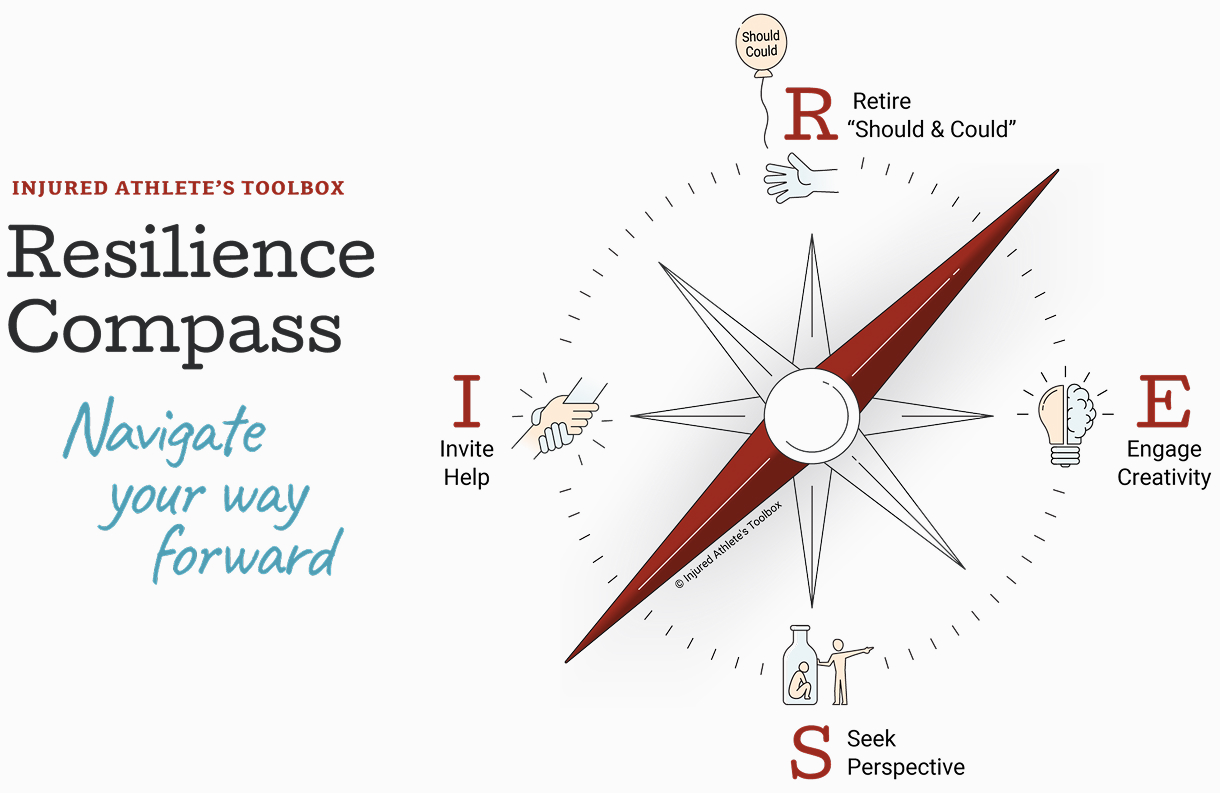
Retire should or could
Language shapes injury recovery more than most athletes realize. If you’re not vigilant, “should” and “could” can sneak in and become unwanted companions as well as constant sources of suffering.
I should be further along by now.
I could do this easily before.
I should be back already.
“Should” compares you to an imagined future version of yourself.
“Could” compares you to a past version that no longer exists.
Both pull you away from the only place recovery actually happens: the present.
Resilient athletes shifted their language toward the present: What does my body need today to move forward?
When you stop resisting reality, you reclaim enormous amounts of mental energy that can go toward mental and physical healing.
Invite help
You are fiercely and proudly independent. You push through discomfort, solve problems yourself, and avoid burdening others. Injury challenges your independence and creates internal friction. You know you need help, but you won’t ask for or accept it, even though you have friends begging to help you.
Through my research, I have found that resilient athletes allowed support in. They accept practical help, emotional support, professional guidance, not because they cannot handle recovery alone, but because they understand something important: Injury recovery is not an individual sport.
Long recoveries demand enormous physical and emotional energy. Attempting to carry that weight alone often leads to exhaustion, isolation, and slower physical progress. Conversely, when you accept help:
- isolation decreases
- resilience increases
- relationships deepen
- recovery becomes sustainable
Inviting help doesn’t make you weak or less capable. It makes you more resilient.
Note: None of these practices eliminate the difficulty of injury. But together, they change how you move through it, shifting recovery from something you simply endure into something that strengthens you.
Seek perspective
Injury narrows your world. Pain, uncertainty, and frustration can create tunnel vision. Then you lose perspective. It’s like being stuck inside a bottle. And when you’re inside the bottle, you can’t read the label.
Resilient athletes had at least one label reader who had good perspective and the love and bravery to speak up when things are headed in the wrong direction.
A label reader tells you the truth (even when it’s uncomfortable), helps you notice blind spots, calls you out when necessary, and keeps you grounded.
They might say:
- You need more support.
- You need to rest.
- This plan isn’t working.
No sugarcoating. Just honest perspective.
The key rule? Your label reader must care deeply about you and know what they’re talking about.
Recovery isn’t meant to be navigated alone. Sometimes progress begins when someone helps you see what you couldn’t see yourself.
Explore creativity
When injury takes away your sport, it also removes your outlet for stress and a core part of your identity. Suddenly, the energy and time once dedicated to your sport have nowhere to go, which can lead to frustration, impatience, rumination, and a fixation on both emotional and physical pain.
Creativity provides a necessary outlet for that energy, and helps give you a safe space to process the mental, physical, emotional, spiritual, and social fallout of injury.
Resilient athletes in my research practiced creativity with the same dedication, consistency, and focus they gave their sport.
Creativity doesn’t have to be artistic or impressive. It looks like writing, photography, cooking, building something, or learning something entirely new in a class.
More on mindset
Posts under maintenance
ONLINE COURSE
Overcoming Injury
You don't have to suffer in silence. Get practical support to help you overcome the mental, emotional, social, spiritual, and physical fallout of injury.
- Learn simple, evidence-based strategies to manage stress, calm mental spirals, and uncertainty.
- Understand how injury impacts your emotions, motivation, and identity.
- Hear honest stories and encouragement from other injured athletes
1-on-1 coaching
You don’t have to recover alone.
Find the right healthcare team | Navigate insurance | Find activities that feel as good at your sport | Talk to another injured athlete who gets it